
In our last conversation, we diagnosed the Busy Paradox, the trap where the "survival work" required to keep the lights on consumes all the time and energy needed for the "innovation work" that actually moves us forward. We agreed that for many innovators, the barrier isn't a lack of money; it is a lack of capacity.
But how do we solve it? "Work smarter, not harder" is a cliché, not a strategy. We need a mechanism, a proof of how to escape.
This week, I want to share a mental model anchored by a new metric: The Bukasa Capacity Score.
I have named it intentionally. As African innovators, we often look to the West for standards and benchmarks. I want to demonstrate that we have the permission to create our own metrics, name them, and use them to solve our unique challenges.
Defining the Score
Most people think productivity is about clearing a to-do list. I disagree. True productivity for an innovator is about surplus capacity. We can measure your state using a simple ratio: Capacity divided by Load.
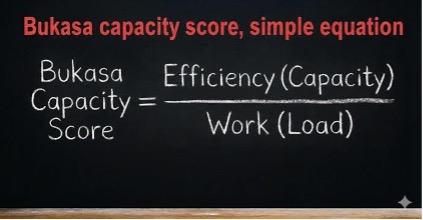
Here is the rule: you want your score to be well above 1.0.
If your score is below 1.0, you are in the Danger Zone. Your workload exceeds your capacity. You are the busy entrepreneur who never launches because you are constantly in debt to your schedule. If your score is exactly 1.0, you are in the Survival Zone. You are breaking even. You meet every deadline, but you have zero energy left for new ideas. This is where dreams die slowly, suffocated by the routine.
The goal is the Innovation Zone, where your score is 5.0 or 10.0. This means your capacity vastly exceeds your survival work, giving you the extra space to climb the 100-step ladder.
The Equation: How to Increase Your Score
To escape the Busy Paradox, you cannot simply try to reduce your Work (which is often impossible). You must aggressively expand the numerator: Efficiency.
The Bukasa Capacity Score relies on three distinct levers to do this: Personal Efficiency (Pe), Intuition (X), and Purpose (Y).

The Linear Trap: Personal Efficiency (Pe)
We all start with Personal Efficiency. This is the combination of your skill, your speed, and the friction in your environment. When we feel overwhelmed, our instinct is to type faster, sleep less, or multitask. The problem is that this lever is linear. There is a physical limit to how fast you can work. Relying on this alone will never get your score to 10; you will burn out long before you reach freedom.
The Additive Lever: Intuition (X)
To move beyond linear growth, we need Intuition (X). In our equation, if n represents your resources (team and tools), X is the hidden multiplier added to them. Intuition is crystallised intelligence, the ability to make the right decision instantly without needing hours of analysis.
A leader with high intuition is worth ten times more than ten extra people. They don't need twenty meetings to solve a problem; they just know where to strike. Developing intuition through deep study and experience adds significant capacity without incurring additional costs.
The Exponential Lever: Purpose (Y)
Finally, we reach the most critical variable: Purpose (Y). In the equation, Purpose is an exponent. It doesn't just add to your capacity; it multiplies it.
Purpose is the alignment you spread to your team. If your team has zero purpose (Y=1), your capacity is limited to the number of people you have; they are just "helpers" waiting for instructions. But if you instil a deep, shared purpose (Y=2 or 3), your team becomes autonomous. They solve problems you didn't know existed. Suddenly, your capacity isn't 10... it is 102 (100) or 103 (1000).
An Invitation to Build
When you combine high Intuition with exponential Purpose, your Bukasa Capacity Score explodes. You stop drowning in work and start surfing on top of it.
I am sharing the Bukasa Capacity Score not as a final law of physics, but as a starting point. In the coming weeks, I will dedicate a specific edition to each variable (Pe, X, and Y).
But I don't want to do this alone. I invite you to critique this model. Look at the formula. Does it hold up? What is missing? Let us debate this, refine it, and ultimately develop a manual that we can all use to build our capacity and beat the busy paradox.